
LYRICAL, INFINITE-GEOMETRY
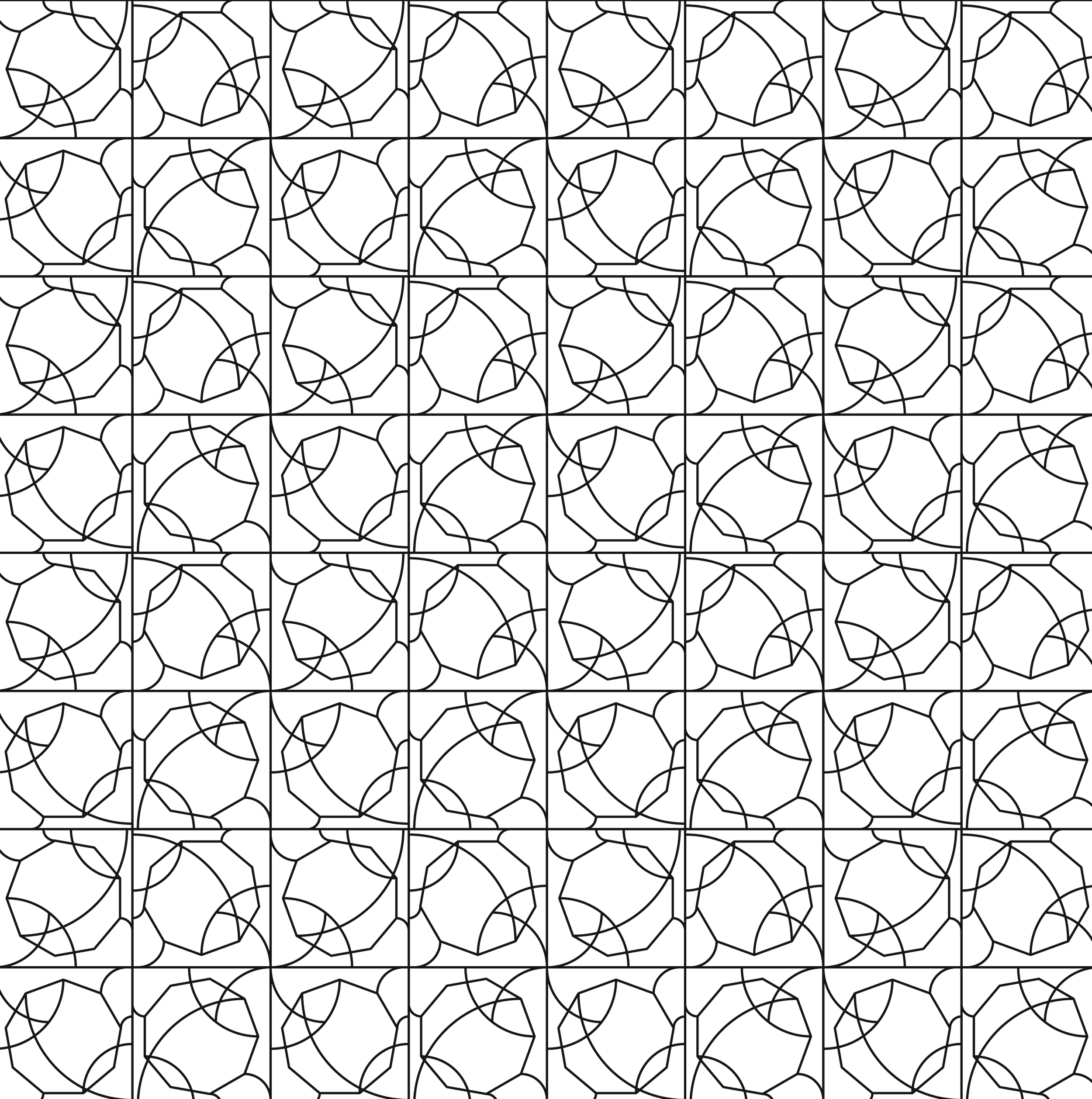
Infinitely Expandable Patterns
Texts by Laszlo Pierlot
• Infinitely extendable mathematical lattice structures.
• This infinity is symbolic: it reflects the infinite and indivisible nature of the cosmos.
• The search for universal truth: through infinitely expandable patterns.
• The appearance of the hidden mathematical codes of the universe in the visual world of the painting.
• Humans tend to treat "infinity" as a distant, unreachable point, think of perspective perception. However, this complex geometry shows infinity 'here and now' through its repetitions.
• The variable, multifaceted geometric structure is an open system: a window onto a detail of the infinite cosmic fabric.
• The goal of spiritual geometry is to find the center, in this case by becoming involved in the quasi-cosmic fabric.
• Order and beauty are not aesthetic luxury, but a means of inner peace and connection with universal systems: from the earthly to the transcendent-universal.


• The clarity of the minimalist visual world is based on the suppression of visual noise, and this is how it wants to affect the viewer, but complex geometry wants to elevate it through the visual order. The former can be thought of as an empty room where there is silence, while the latter as a perfectly tuned chord that echoes to infinity. Both provide peace, but the latter also carries a deeper, transcendent truth.
• The observer of the silence of minimalism escapes information overload. For him, peace is reduction: when there is no stimulus, there is no tension. This is the aesthetics of mental pause. On the other hand, infinite complex geometry is not based on lack, the eye rests because wherever it looks, it finds regularity and meaning. This is not a pause and a void, but an intellectual engagement: the soul does not switch off, but tunes in to a higher vibration.
• Emptiness, nothingness, can be frightening or meaningless, because it does not reflect the presence of the Creator, who is “everywhere.” A bare surface can appear unfinished or lifeless to the eye—as if it lacks a soul. However, the aesthetics of patterns, the denser, infinite complex geometry, reveals completeness: it speaks to the soul. For some, this very “filled” surface is suffocating: they identify freedom with empty space. They feel the pattern as a constraint or an unnecessary complication that obscures the essence. In fact, the aesthetic stance of the middle way could be the savior, in which there is room for omission as well as condensed content.

• A minimalist work, such as a wall object, is a self-contained, closed unit: its boundaries and texture can be observed by the recipient, that is, it is object-like. While the infinite-geometry pattern is not object-like, but part of an expansive network. It has no real boundaries. While in the former we look at one thing, in the latter one sees an interconnectivity, a process. The more uplifting recipient experience here comes from the fact that the individual dissolves in this infinite fabric and does not feel isolated.
• Minimalism is quite intellectual, you have to understand the concept, the art historical context, and perhaps discover the ideal proportions. The multifaceted, infinite geometry based on omission and condensation also builds on strong intellectual foundations. But it is not up to the observer to fully understand the patterns and the underlying historical relationships, but rather to let them be drawn into the structured, expandable spectacle with a kind eye. During the mental operations, they can experience cosmic scales. The geometrically based motif system is already transforming: the overall spectacle becomes lyrical, providing the soul with both homeliness and transcendent certainty.
SPLENDOUR OF BLACK
« LA SPLENDEUR DU NOIR • Avec 43 pigments noirs différents »
BUZZWORDS • CATCHPHRASES
Play of pigment differences • the depth of matte black • black shining up • light-reflecting appearance • velvety, material-like matte black • the paradoxes of impasto black paint • painterly commitment • the colorfulness and richness of black • geometry in monochrome • paint-texture dynamics • lyrical, infinite-geometry • vertical-horizontal rasters • patterns by polygons • spontaneous attitude and absolute consciousness • by the regular nine-sided polygon • complex, variable options • infinitely expandable patterns • quasi a “black diamond” • elegant black, the elegance of black • the splendour of black has a noble meaning • towards wholeness through play • orientation towards the transcendent • involvement in spheres on the other side • universal spiritual operations • mediation • contemplation
• The brilliance of black is fundamentally ensured by the variety of quality pigments, and this is further modulated by the dynamics of brushwork and paint texture.
• Creating with more than forty black pigments: bluish, brownish, greenish, purple or even graphite, iridescent blacks, glossy or matte, give the monochrome a "rich and colorful" look.
• The impasto black paint creates paradoxes: sometimes it shows its light-reflecting face, sometimes it melts back into the darkness of the base, that is, it is phenomenal and fleeting, uplifting and leading into depth. In the painterly variety, sometimes the geometrizing pattern, sometimes a lyrical gesture emerges in the suggestive flood of light, and as its counterpart in the velvety matteness.
• All this painterly commitment, the practice of the joy of painting, is built on a complex geometric structure. In other words, we can say that the spontaneous attitude is combined with absolute consciousness: this is how the painter's imagination becomes total, and only in this way can the creator express the desired completeness.
• Polygons play a decisive role in the formation of this geometric grid. For example: the surface formed by the interplay and details of the regular polygons, nonagons are extremely diverse, each of the polygonal elements are different, no two are the same. Yet we can perceive harmonious relationships, even associating them with a crystal structure: a quasi “black diamond” is formed, created by the variable blacks and geometric patterns. This game is both light and serious: totality is revealed to us in this way.
• The splendour of black has a noble meaning: it secretly suggests the possibility of being drawn into the transcendent. The orientation towards spirituality on the magnificent, sumptuous black canvases is rooted in the painter's habitus: through the brilliance and discreet splendour of black, he wishes to draw the viewer into the transcendental spheres. In this subtle, universal spiritual operation, the elegant black imagery is not merely imposing, not "beautiful for its own sake", but wants to provide additional content, and is capable of doing so.

VISION – ARS POETICA
My aim is to develop a “lyrical, infinite-geometric, transcendental splendour-black painting” whose elegance resonates with the refinement of French perfumes, fashion, and haute couture. For me, the quintessence of painting lies in vision: creating works in which consciousness (geometry) and spontaneity (lyricism) merge organically. I strive to establish a contemporary visual language aligned with the demands of the 21st century – one capable of synthesizing and distilling the essence of diverse cultures, acting as a bridge between East and West, and offering intellectual grounding for the present and a vision of a livable future.
